
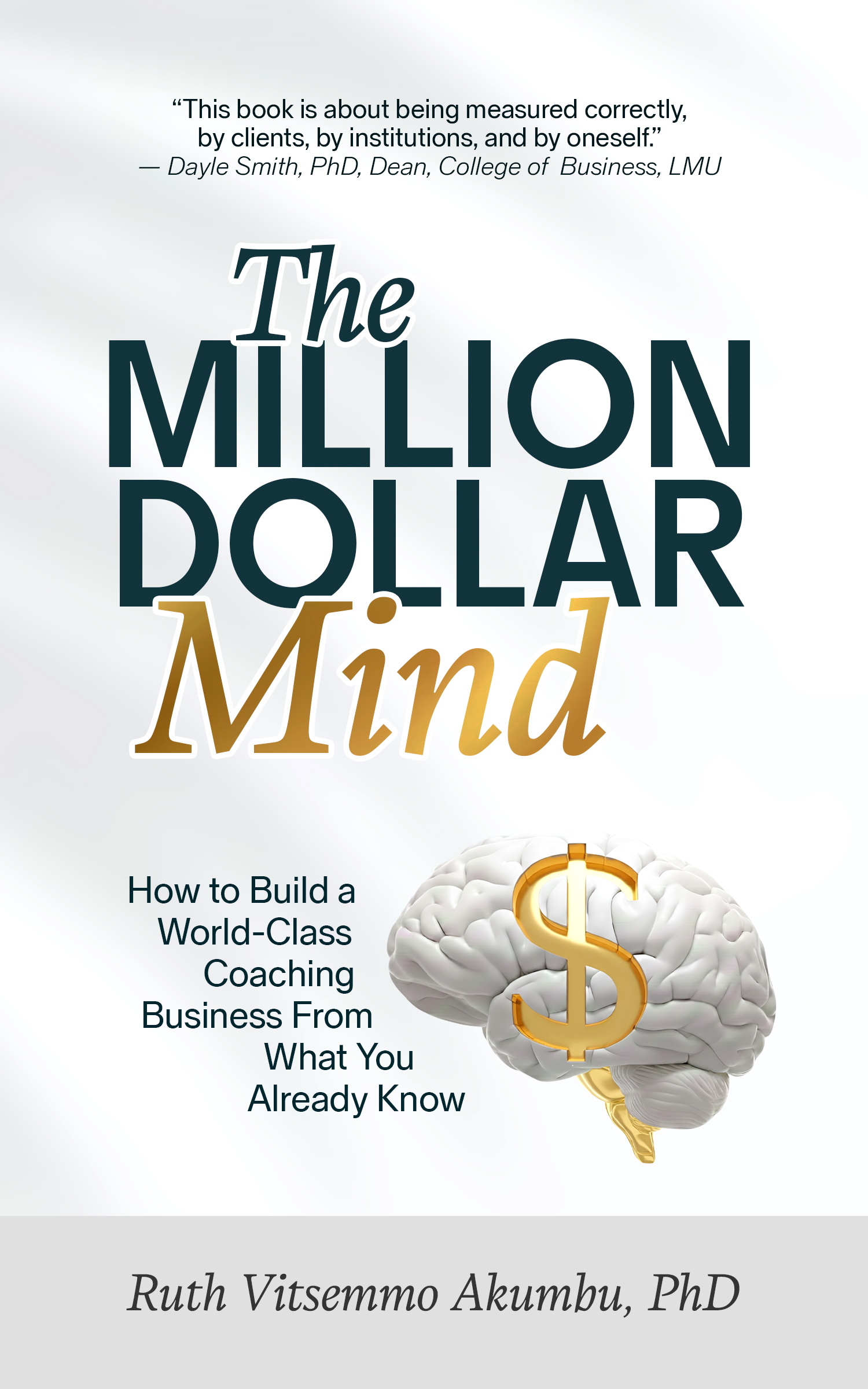
Description
About This Book
The Million-Dollar Mind is a practitioner-tested framework for experienced professionals, coaches, consultants, and leaders who have accumulated significant expertise yet remain chronically underpriced.
Born from the author’s own coaching journey, this book rejects time-based pricing in favor of a model built on quantified formation, outcome-based delivery, and compounding proof.
It challenges the identity narratives that keep skilled professionals stuck: the fear of overcharging, the confusion between generosity and availability, and the belief that more hours equal more value.
Through five causally connected parts, you will learn to document your total professional investment through the Value Ledger, package your expertise into repeatable, structured offers using the POI Model, build visibility through proof-based communication, and create systems that deliver value long beyond direct engagement.
Practical tools, including the Value Ledger Worksheet, Decision Support System, Boundary Health Diagnostic, and Proof Capture Template, give you everything needed to transform your expertise into visible, defensible, and scalable professional value.
Written from the middle of the author’s own transformation rather than from the summit of declared success, this is a practitioner’s guide to finally being measured correctly.
“The value is already in your hands. This book shows you how to make it visible.”
Outside North America:
Preorder here
Endorsements
— Dayle Smith, PhD
Dean, College of Business Administration, Loyola Marymount University
As a dean and long‑time evaluator of leadership development, executive education, and professional practice, I rarely encounter a coaching book that genuinely advances the field. The Million‑Dollar Mind does exactly that.
What distinguishes this book is its insistence that coaching be treated not as an informal conversation or personality‑driven service, but as a disciplined, evidence‑based profession. Ruth Akumbu offers a rigorous framework for understanding value, one that moves beyond hourly pricing and subjective confidence toward documented formation, measurable outcomes, and defensible proof. The result is a model that resonates deeply with how we evaluate expertise and impact in academic and executive settings alike.
For professionals aspiring to become coaches, this book provides something unusually practical: a clear architecture for turning accumulated knowledge into structured, repeatable value. The Value Ledger, the POI Model, and the emphasis on proof‑based practice give readers concrete tools for building a coaching practice that is ethical, sustainable, and scalable, without relying on hype or performative marketing.
Equally important, The Million‑Dollar Mind is invaluable for executives and organizations seeking an executive coach. It clarifies what high‑quality coaching should look like, what questions to ask, and what evidence to expect. In a marketplace crowded with promises, this book offers a way to distinguish credibility from charisma.
This is not a book about charging more for the sake of it. It is a book about being measured correctly, by clients, by institutions, and by oneself. I see it as essential reading for anyone serious about coaching as a profession, and for leaders who want coaching that delivers durable, documented results.
— Eugene P. Kim, PhD
Chair, Organizational Change | Professor of Leadership, Concordia University Irvine
This book is relevant and potentially impactful for many who struggle with their value proposition and with outcome-based engagement. What I find particularly compelling is the 2.5% valuation principle.
The counsel you provide can be shocking to those who have undervalued themselves for so long. You provide a reframing that can help coaches recalibrate how they understand their worth. And though destabilizing at first, the goal is to challenge the prevalent and persistent narratives we perpetuate.
This would be a great companion to any coaching curriculum, helpful not only to emerging coaches but to seasoned practitioners who have fallen into these self-diminishing patterns.